

AI: That can Never Be Real!
“Sneha Viresh Bagdiya”
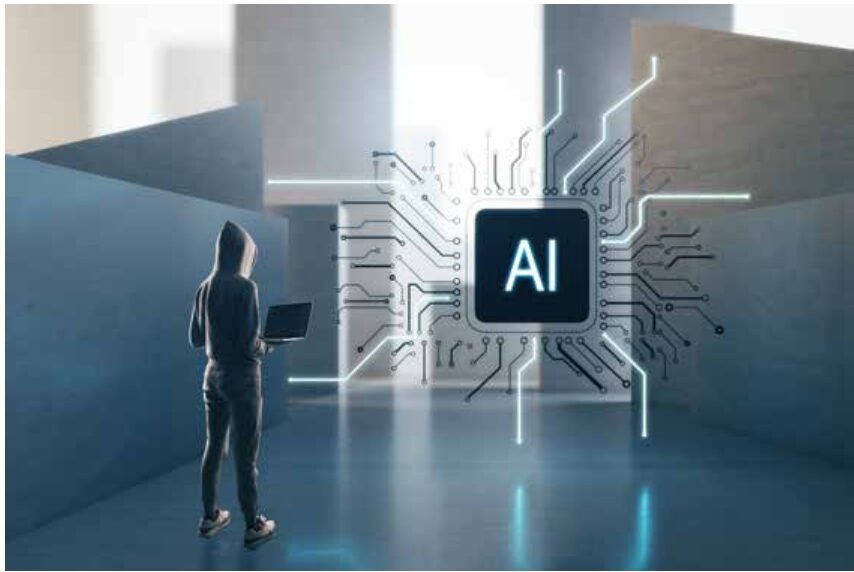
Artifcial Intelligence is rapidly transforming the modern world, enhancing efficiency, automating tasks and reshaping how we access information. While its potential is immense, it also presents growing concerns around overdependence, privacy, eth-icalboundaries and loss of human creativity. As Al becomes more autonomous and deeply integrated into daily life, the line between tooland control begins to blur. This article examines the dual nature of Al – its benefts andrisks – emphasising the need for responsible use to ensure that technology strengthens, rather than diminishes, human intelligence and societal well-being.
The immense potential of this neoteric technology can’t be ignored, but while reaping fruits who heeds the flip-side, even if it might possibly extend to threaten human existence? It is a double-edged sword in the human demesne. The beauty of agentic Al to learn and adapt autonomously is dangerous, extremes of sophistication it falls in introduces newer, unsought intricacies when exploited by antisocial elements with profound malicious intent.
Evolution :-Al’s ability to learn anu adapt autonomously makes it powerful, but when exploited with malicious intent, it can pose serious threats to humanity.
Al was built in the quest to perfection to eliminate human errors. It can brilliantly amplify human efficiency, but whether we make it a tool to empower or a spine to weaken us, depends on HOW WE USE!
Al is a mirror held up to what we value, depth or convenience and what we demand, spectacle or substance. Al exists because the human mind made it, but overreliance makes it a reflection of utter impatience over matchless brilliance.
Who cares to think why the world was offered an endless pool of information in the 1990’s? Was the free content and storage, a gift of technology or a bait to harvest our mind? The
data that we poured with every query and upload fueled the machine for an acumen that feeds on the brains that built it, to mock its own makers. Our ignorance and extreme dependence have slayed its essence, what was designed to assist has inadvertently begun to rotten our minds.
Original is passé, artificial is the new real!
Aren’t we eroding originality and embarrassing real talent for the sake of convenience and speed, on grounds that we don’t even need? Can just one inane prompt replace the life-long dedication
of an author to command language, of a designer to create a masterpiece, of a photographer to build the stability/patience to capture one perfect shot, or of an artist to breathe life into art? Nay! Every essay, every stitch, every frame and every brushstroke has held the essence of its creator shaped by spontaneity,
emotions, flaws and experiences that no machine can imitate! Mona Lisa remains irreplaceable despite innumerable flawless digital reproductions. Hand-embroidered and hand-painted fabrics hold a lot more value than machine-perfect embroidery or immaculate prints in the trillion-dollar fashion industry.
Al-generated content risks replacing genuine human creativity, reducing years of skill and emotional depth to instant outputs.
Al can only SIMULATE based on existing data, not create. It is bizarre that creators themselves are relying on Al tools to generate ideas and this interminable dependence is not only waning creative instincts but also flooding the world with content that is stale, redundant and meaningless. Queerly, humans are at the mercy of imitated counterparts. Absurdity of this digital age is the submission of real intelligence’ to its ‘artificial version’. While chasing speed, we chose to lose what made human creation, deeply human.
Al in behavioral learning: End of Privacy Al has the finesse to tailor content to create a biased inclination and this silent manipulation is unethical. Recalling 2016 US elections, where Al analyzed social media data of over 87 million users (without consent) to build psychological profiles delivering personalized political content to influence voter behavior. Another unnerving move is using emotion to drive addiction. It is a sheer neuropsychological abuse as algorithms exactly know when the young minds are sad, happy or angry and designed to engage tragile minds accordingly.
Al systems built for surveillance track our online / offline movements for government, public/private sectors. China’s social credit system relies on Al and facial recognition technology, Vietnam is close to launching ‘digital citizen’ rating system, Moscow uses more than 1,50,000 cameras to detect suspicious behavior and cities like London use automated facial recognition systems to scan crowds. While Al holds the promise of transformation, the potential risks to human safety and privacy are REAL because of this artificial tool. In Al era, we are the product of a massive network built upon data of our lives and once data leaves our devices,
it becomes immortal. Systems own us.Our mundane digital companions like Amazon, Google, Meta don’t just monitor what we say, but also keep a concentrated record of what we feel in terms of typing speed, voice tone, facial expressions, heartrates (monitored by wearables) and more to determine emotional states to optimize engagement. Vast amounts of consumer data are continually scanned to build comprehensive user profiles that can be sold to advertisers. Lures of instant gratification entrap users in an intensely controlled environment, proving that people no longer control their own opinions, ALGORITHMS DO!
Al Generation – Downloading dreams!
Al hollows the core curious learning that makes childhood fascinating. Most students today only effort to copy paste feeling thinking is optional. When Al is used to question on behalf of teachers and answer on behalf of students, only the machine learns in classrooms with no minds. When both the sides of learning coin outsource their intellection, we raise a generation that is trained to submit, embracing convenience over curiosity and downloading dreams instead of chasing them.
Despite advancements, the human brain remains more energy-efficient, adaptive and creatively superior to machines.
Al in Cybercrime: Stealing future, byte by byte
Al automates cyberattacks at speeds humans can’t match. A 4000% increase in phishing attacks is seen since Generative Al was introduced (Late 2022) and 3.4 billion fake emails are sent every day. Absurdly, these Al emails (taking minutes to launch) achieve more than 50% click through rate compared to 10-15% for human crafted fake emails (taking days, Pre-Al). Al driven phishing attacks look believable as they meticulously adapt to each victim’s unique style, closely mirroring genuine human communication using LLM and eradicating inconsistencies.
Al can also launch denial-of-service attacks and sabotage crucial control systems like water, traffic, power grids. Al driven malware and ransomware are harder to detect, contain and eradicate as they bypass traditional defenses, adapt to security measures and pick their targets identifying vulnerabilities in any network.
Deep fake Al creates hyper-realistic fabricated videos (1st deep-fake instance came to light in 2019 where a cloned audio of a CEO was used that costed a British company $2,43,000). Cybercrime may cost $20 trillion annually by 2027 (Data destruction, post-attack recovery, direct financial losses), according to the Statista Cybersecurity Outlook – Global Security Mag.
Al in Autonomous Weapons: Ethical Dilemmas
The most controversial use of Al, I feel is developing autonomous weapon systems where machines with no human intervention can independently identify and engage targets. It may reduce casualties at warfront, but the risk to allow a machine to make a life and death decision stands beyond my comprehension. No matter how evolved these systems seem in future, can they ever counter the risk of Type 1 Error (false positive) when systems misinterpret human behavior? Anxiety can be mistaken as hostility, or a high energy gathering like Spain’s La Tomatina could be misidentified as a rampage. An ethical dilemma will always hover – how do we ever hold a machine accountable for an action or vent the legal vacuum created due to this accountability gap? Autonomous weapon systems thus, must be banned.
Building systems for whom? A better ‘MORE HUMAN’ or ‘MORE MACHINE’ world?
Al systems lack empathy and are opaque. The Black Box concern needs to be sorted out (when developers fail to trace how machine reached a decision). Predictive Al must be under the etnica window and adhere to the law with no room for unconsented data. Developers must be accountable for misuse. Our dependence on Al has become so profound that we have willingly let it coach us, but can we let it outgrow human control? Only if machines knew how to think, we would have lost our world to technology long back.
Invoice of a single innocuous innocent looking prompt- A sip for the machine, a drought for the dessert!
Clicks aren’t free – every hit on the keyboard is a hit on the planet. The speed and convenience we barely care to notice has fueled storms, melted ice, heated oceans. To quickly answer an insignificant question, invisible energy flows through massive data centers burning fossil fuels and pumping CO2 into our planet that is already struggling to breathe. One single prompt means zilch but billions every day bleed Earth dry of all its resources. Experts in the Byteplus stated that global systems had processed 15 billion Al prompts daily by 2025, which means 3.6 GWh of electricity burnt – enough to power a typical Indian TV for 1 billion hours, emitted 450 tons of CO2, same as a car circling equator 40 times, and drank 4 million liters of freshwater, enough drinking water for a million people, just to cool its overheating servers every single day – all this only to equip systems so that someone can ask a ‘harmless’ question? The new labor divide: Al – Perfect executor; Human Mind – Innovator! We can let go repetitive boring jobs like data entry, drafting, scheduling emails, screening resumes, generating reports. Farmers can access knowledgebase in local language, small business owners can use business analytics to evaluate growth and identify loop holes, with personalized tutoring students can learn at their own pace, it can reduce wastage and optimize resources in logistics. The key is to carefully balance the offline cost of online actions. But the human mind today fails to identify the thin line between using or being used by its creation.
From social media to surveillance systems,Al tracks behavior, emotions and movements, making individuals part ofa vast data network.
Good Citizenship – Make it the next favorite Al trend!
Al can hype even normalcy, like it turned an ordinary practice of wearing a saree into a viral trend. Social media exploded with millions of Indian women in retro styled flawless drapes generated by Gemini, as if our Indian heritage attire needed an algorithmic validation.
Likes and shares fueled the fire, making a simple daily habit feel so aspirational.
Conversely, ‘The Chat GPT Al generated Studio Ghibli Trend’ was a masterclass for systems to extract sensitive biometric face geometry in exchange of a cartoon selfie, and the genius of this bait was that users traded their permanent digital identity (saved on third-party servers roaming freely to be used for biometric frauds) for an insignificant temporary profile picture.
Why can’t we use Al to rewire responsible public behavior? From thoughtless clicks to real actions, Al driven trends can redefine civic sense too if it can make a saree or a caricature go viral overnight. What if doing the right things actually felt like fun? Imagine Al-generated challenges showing citizens who voluntarily participate in No litter drives, waste segregation, tree plantation, traffic sense, sustainability, achieving zero waste or quashing plastic use! Once this content overwhelms internet, people will feel proud to participate and post content while doing their bit towards the society. Turning responsible behavior into a game or a trend with points, civic pride badges and local leaderboards could turn good habits into viral moments. Imagine schools, societies and cities competing for recognition where being civically responsible looks cooler than ever!
By using the same psychology behind viral online trends, Al can swiftly nudge millions to adapt civic sense without any pressure, inspiring tremendous engagement and shape a culture of accountability, positively impacting the society we live in!
Beyond algorithms – The irreplaceable human mind!
The humble human brain uses about 1.25 million times LESS power than a super computer, yet its more resilient and adaptive having the ability to self-repair/reroute after damage unlike supercomputers having zero fault tolerance that collapse on one single hardware/ software glitch. Even the world’s most advanced supercomputers (merely capable of storing raw data that stands meaningless until meaningfully processed cannot match human brain’s effortless creativity, learning and emotional understanding. In the race of intelligence, intuition will always win over instruction.
Final Verdict
Al is not a neutral tool but an active threat to human mind if recklessly deployed. Stop letting machines do what you were born to do. A day will come when your wit and your planet may fail to survive another shortcut.
With great Al power, comes greater human responsibility! I unwaveringly believe that despite all the evolution, Al stands utterly incapable to outshine, overshadow or override genuine human intelligence without human accord.
(Writer is Cyber Crime Investigator)