IT Security. Surakshit Sansar
India’s educational landscape is undergoing a significant transformation, marked by the increasing integration. of technology and digital platforms into teaching and learning processes. While this digital shift has brought numerous benefits, it has also exposed Indian schools and students to new risks, particularly in the areas of cybersecurity and the influence of social media. As the education sector embraces technology, it is crucial to understand the challenges that cybercrime and social media pose, along with strategies to address these issues and safeguard students’ well-being.
The Escalating Cyber Threat Landscape
Indian educational institutions are increasingly becoming targets of cyberattacks. A report from Check Point Software Technologies highlights that educational institutions in India experience an average of 8.195 cyberattacks per week-more than double the global average of 3,355. These attacks often include ransomware, phishing, data breaches, and the exploitation of outdated systems. As schools rapidly digitize and expand their online presence, they have become vulnerable to data breaches that compromise sensitive student and institutional information. The shift to remote learning during the COVID-19 pandemic has exacerbated this issue, with the increased reliance on digital platforms creating a larger attack surface for cybercriminals. Common forms of malware. such as Formbook, Qbot, and Fake Updates, have been
identified as major threats, often delivered through email, with a significant percentage of attacks involving.exe files. Cybercriminals exploit these vulnerabilities to steal personal, academic, and financial data, which is frequently sold on the Dark Web.
Social Media’s Impact on Student Safety
In addition to cybercrime, the pervasive use of social media among students presents significant challenges. According to the Annual Status of Education Report (ASER) 2024, 76% of children aged 14-16 use smartphones for social media, compared to 57% using them for educational purposes. This growing engagement with social media has raised concerns about its effects on students’ mental health, academic performance, and safety.
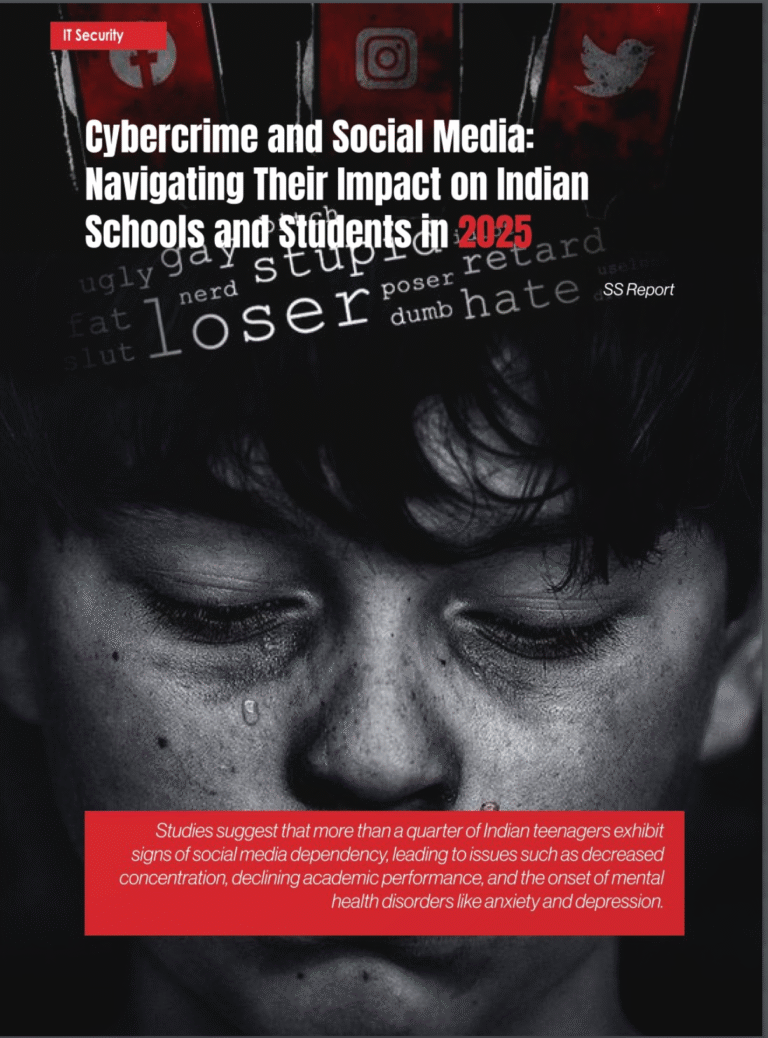
Studies suggest that more than a quarter of Indian teenagers exhibit signs of social media dependency, leading to issues such as decreased concentration, declining academic performance, and the onset of mental health disorders like anxiety and depression. The rapid adoption of social media, coupled with a lack of digital literacy, means that students are often ill-prepared to manage online risks. Despite high usage rates, many students lack the necessary skills to secure their online profiles or protect themselves. from cyberbullying and other threats.
Government Initiatives and Strategies for Enhancing Cybersecurity
and Digital Literacy
Recognizing the growing challenges, the Indian government and educational institutions have launched various initiatives to improve cybersecurity and digital literacy. These efforts aim to safeguard students and educators from digital threats while promoting responsible and safe online behavior.
Cybersecurity Awareness
Campaigns: Programs to educate students about cyber threats, such as phishing scams, online frauds, and cybersecurity best practices, are being implemented to reduce the risk of financial and emotional harm.
Digital Literacy Programs: The integration of digital literacy into school curricula is essential. These programs equip students. with the skills to navigate online environments safely, addressing issues such as misinformation. cyberbullying, and privacy violations. Efforts like the Information Security Education and Awareness (ISEA) Project are training educators and students on safe online practices.
Mental Health Support: As the psychological impact of excessive digital engagement becomes more apparent, mental health support programs are being introduced to help students cope with stress, anxiety, and depression linked to social media and cyber threats. The UNODC’s Rise Up4Peace initiative in Guwahati exemplifies this approach, integrating mental health support within schools.
School safety is the foundation on which all learning is built
सुरक्षित संसार (Safer World)
Article use for :- Cyber safety , School safety, Cybersecurity India, Student safety, Online safety, Cybercrime awareness, Smart schools, Cybersecurity support, Impact of cybercrime on Indian schools in 2025 , How to protect students from cyberbullying online, Digital literacy programs for school children in India, Best practices for online safety in schools, Role of parents in ensuring student online safety, Importance of mental health support for teenagers using social media, Cybersecurity measures for protecting school data systems, Social media effects on student focus and education, How schools can prevent online abuse and cyber threats, Stress and anxiety in teenagers due to cybercrime.