
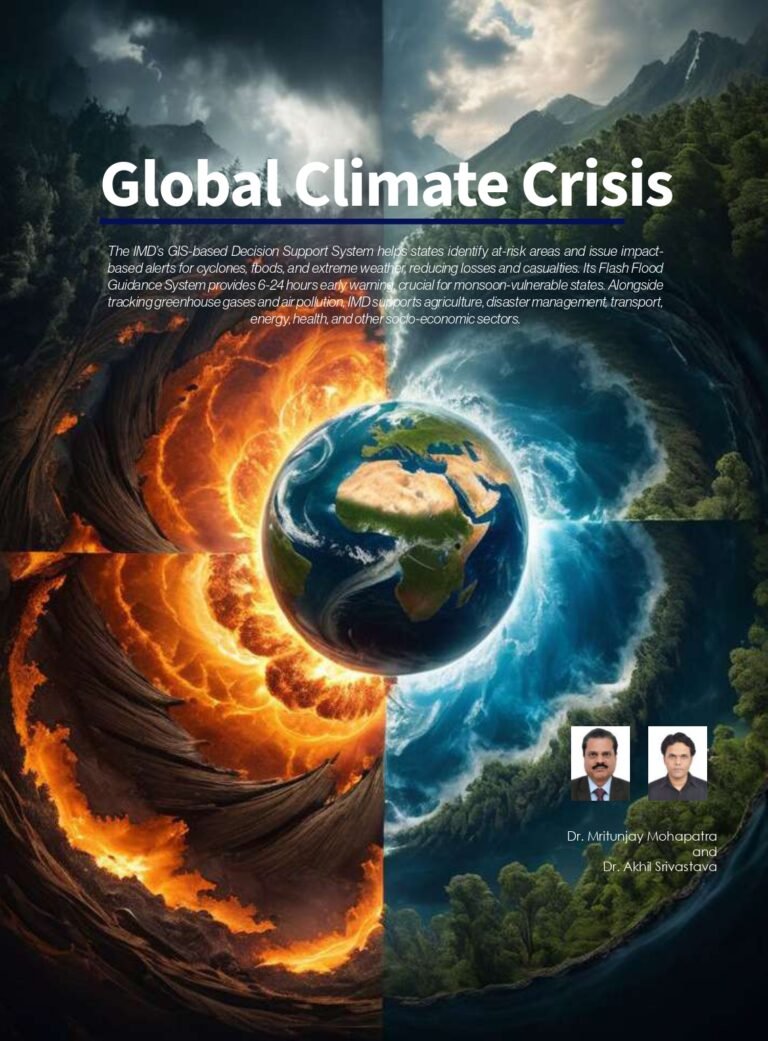
“According to IMD, 2024 was the hottest year in India since records began in 1901, with average land temperatures climbing +0.65°C above normal. The country has also seen a spike in intense rainfall, more frequent droughts, floods and Heat Waves and a sea-level rise of 3.3 mm per year in the north Indian Ocean, and increasingly powerful cyclones in the Arabian Sea.”
India, of the opin climate crisis, is witnessing a surge in extreme weather-from record heatwaves and intense rainfall to rising seas and stronger cyclones. At the heart of the country’s response stands the India Meteorological Department (IMD), an institution that has transformed itself to meet the escalating climate challenge.
According to IMD, 2024 was the hottest year in India since records began in 1901, with average land temperatures climbing +0.65°C above normal. The country has also seen a spike in intense rainfall, more frequent droughts, floods and Heat Waves and a sea-level rise of 3.3 mm per year in The north Indian Ocean, and increasingly powerful cyclones in the Arabian Sea.
These shifts, driven by climate change, threaten agriculture, water security, public health. and urban infrastructure. Their impact is most visible in deadly heatwaves, heavy rainfall. and coastal surges that disrupt millions of lives.

A Changing Mandate Founded in 1875. IMD once focused mainly on weather forecasts for agriculture and shipping. Today, under the Ministry of Earth Sciences, it operates a cutting-edge network of satellites, radars. and high-performance computers. Its role now includes real-time climate monitoring, impact-based forecasting, and direct community outreach. Early Warning Services & Impact-Based Forecasting in IMD The India Meteorological Department (IMD) has significantly expanded its early waming systems to address the challenges brought about by climate change. saving countless lives and reducing economic losses. IMD’s wamings are generated using real-time surface and upper-air meteorological observations, high-resolution weather models, satellite and radar data, and different forecasting modules. IMD has enhanced its strategy from reporting “what the weather will be” to also covering “what the weather will do.” These innovations emphasise impact-based. people-centric warnings that inform not just about potential hazards, but their likely effects on infrastructure and human life. This impact-based forecasting focuses on health risks, infrastructure damage. and livelihood disruptions. For example, during heatwaves, advisories highlight risks for outdoor workers, children. and the elderly, along with safety measures. This approach lets local authorities target interventions such as evacuation, resource mobilisation, and shelter activation more precisely. The IMD’s GIS-based Decision Support System (DSS) helps state agencies quickly identify at-risk areas and track hazards such as cyclones and floods for rapid response. DSS integrates severe weather modules, providing location specific, impact-based alerts for cyclones, rainfall, and temperature extremes, drastically reducing casualties and economic losses. IMD’s Environmental Monitoring and Research Centre tracks greenhouse gases and air pollution in partnership with the Environment Ministry, and IMD’s Flash Flood Guidance System (FFGS) uses observed and forecasted rainfall, soil moisture, and river data to provide early advisories for flash floods-with lead times ranging from 6 to 24 hours. It is especially important for states highly vulnerable to monsoon-triggered events. IMD supports different socio-economic activities, in agriculture planning, disaster management, surface, air & water transport, power and health, and various other sectoral applications.
Multi-Model Ensemble (MME) Approach: Redefining Forecast Accuracy
IMD adopted the Multi-Model Ensemble (MME) technique to enhance forecast precision. By integrating outputs from multiple global and regional models, IMD can better estimate probabilities and uncertainties for Seasonal rainfall. Heatwave and cold wave outlooks, and Extreme weather predictions. This approach increases the reliability of forecasts and assists in formulating data-driven strategies for diverse stakeholders.
Mission Mausam and BharatFS
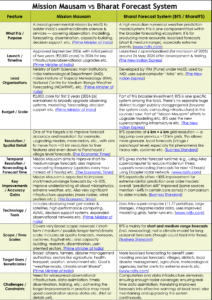
To strengthen preparedness, the government launched Mission Mausam, a flagship initiative to make India “weather-ready and climate-smart.” A major breakthrough under this mission is the Bharat Forecasting System (BharatFS), the world’s highest-resolution operational weather model with a 6 km grid. II provides hyper-local forecasts down to the panchayat level. improving predictions for heatwaves, thunderstorms. and heavy rainfall. Mission Mausam integrates artificial intelligence (AI) and machine learning (ML) into forecasting workflows, allowing for more nuanced pattern detection, anomaly identification, and prediction accuracy. This empowers not only scientists, but also last-mile users-farmers, planners, and emergency responders-with actionable intelligence. Climate Services based Policy Support IMD also extensively work to drive national climate science and services, IMD has come up with the National Framework for Climate Service (NFCS) to support the climate services for different high-priority sectors. IMD conducts research workshops and trainings. Issues State-Wise Annual Climate Statements, enhances transparency and localised preparedness and produces vulnerability atlases and hazard maps to aid government and sectoral planning. IMD has created a Climate Hazard & Vulnerability Atlas, enabling agencies to identify flood, drought, and cyclone risks. IMD publishes monsoon and temperature outlooks at seasonal, monthly, and weekly timescales, critical for agriculture and disaster preparedness. Outreach for Communities IMD has adopted modern dissemination channels and blended them with traditional broadcasts on digital platforms like SMS. social media networks, app notifications, website updates, radio, and TV. IMD uses Common Alert Protocol (CAP) for standardised emergency communication. Real-time information is shared with NDMA. SDMA, Central Water Commission (for floods), state and district administrations. etc. To connect directly with citizens, IMD has rolled out several digital apps. like:
- MAUSAM app for general forecasts
- Meghdoot for farmers
- Damini for lightning alerts
IMD runs extensive public awareness campaigns through workshops, exhibitions, and school seminars (such as IMD@150 events), public lectures, Farmer-focused initiatives (e.g.. Meghdoot app for Agro-advisories) and Collaborations with media and civil society to amplify reach. These platforms make early warmings more accessible. especially for rural and vulnerable populations. Multisectoral Collaboration IMD collaborates closely with the National Disaster Management Authority (NDMA), central and state ministries, and organisations like Indian Railways and Health. Departments. Early warnings flow through multiple channels. reaching every level from state disaster authorities to village leaders. IMD collaborates with the World Meteorological Organisation (WMO). regional meteorological centres, and leading global weather agencies and exchanges technical practices, data and insights. These linkages strengthen India’s ability to adapt to global climate risks and advance meteorological science
The Road Ahead
Despite significant progress, challenges remain, such as
- Expanding coverage in remote areas and ensuring last-mile delivery of climate services to remote and vulnerable communities.
- Improving forecast communication so that public understanding of forecasts makes it more usable and actionable for non-specialists.
- The data integration is also challenging, considering the amount of dala analysed for forecast generation. Synthesising all this information from diverse sources for actionable insights would be required.
- and bridging the last-mile gap so that vulnerable communities receive timely alerts.
The future lies in harnessing Artificial Intelligence (Al), big data, and satellite technology for sharper, faster, and more accessible forecasts.
A Pillar of Climate Resilience IMD stands as one of India’s most vital institutions in the fight against climate change. responding with relentless scientific innovation, real-time outreach, and an unwavering focus on resilience. The department’s evolution from traditional meteorological tasks to a central pillar of India’s climate action story is a testament to the power of adaptation and foresight.
Through Mission Mausam, BharatFS, impact-based alerts. and a spirit of national service,
the IMD offers a model for 21st-century meteorology-where science, society, and sustainability are deeply intertwined. The path ahead will require even greater cooperation, investment. and technological creativity. With its legacy of excellence and a future-focused mission, IMD is well-positioned to help India weather the storms of a changing climate.
(Dr. Mohapatrais Director General of Meteorology, India Meteorological Department & 3rd Vice President of the World Meteorological Organisation. Dr. Srivastava is Scientist, India Meteorological Department).